 Add to Chrome
 Add to Firefox
 Add to Edge
MedMemoryBench: Benchmarking Agent Memory in Personalized Healthcare
May 12, 2026
The large-scale deployment of personalized healthcare agents demands memory mechanisms that are exceptionally precise, safe, and capable of long-term clinical tracking. However, existing benchmarks primarily focus on daily open-domain conversations, failing to capture the high-stakes complexity of real-world medical applications. Motivated by the stringent production requirements of an industry-leading health management agent serving tens of millions of active users, we introduce MedMemoryBench. We develop a human-agent collaborative pipeline to synthesize highly realistic, long-horizon medical trajectories based on clinically grounded, synthetic patient archetypes. This process yields a massive, expertly validated dataset comprising approximately 2,000 sessions and 16,000 interaction turns. Crucially, MedMemoryBench departs from traditional static evaluations by pioneering an "evaluate-while-constructing" streaming assessment protocol, which precisely mirrors dynamic memory accumulation in production environments. Furthermore, we formalize and systematically investigate the critical phenomenon of memory saturation, where sustained information influx actively degrades retrieval and reasoning robustness. Comprehensive benchmarking reveals severe bottlenecks in mainstream architectures, particularly concerning complex medical reasoning and noise resilience. By exposing these fundamental flaws, MedMemoryBench establishes a vital foundation for developing robust, production-ready medical agents.

OmniRAG-Agent: Agentic Omnimodal Reasoning for Low-Resource Long Audio-Video Question Answering
Feb 03, 2026Long-horizon omnimodal question answering answers questions by reasoning over text, images, audio, and video. Despite recent progress on OmniLLMs, low-resource long audio-video QA still suffers from costly dense encoding, weak fine-grained retrieval, limited proactive planning, and no clear end-to-end optimization.To address these issues, we propose OmniRAG-Agent, an agentic omnimodal QA method for budgeted long audio-video reasoning. It builds an image-audio retrieval-augmented generation module that lets an OmniLLM fetch short, relevant frames and audio snippets from external banks. Moreover, it uses an agent loop that plans, calls tools across turns, and merges retrieved evidence to answer complex queries. Furthermore, we apply group relative policy optimization to jointly improve tool use and answer quality over time. Experiments on OmniVideoBench, WorldSense, and Daily-Omni show that OmniRAG-Agent consistently outperforms prior methods under low-resource settings and achieves strong results, with ablations validating each component.
KBQA-o1: Agentic Knowledge Base Question Answering with Monte Carlo Tree Search
Jan 31, 2025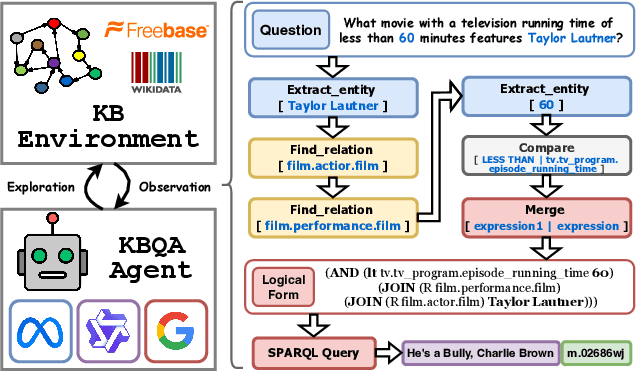


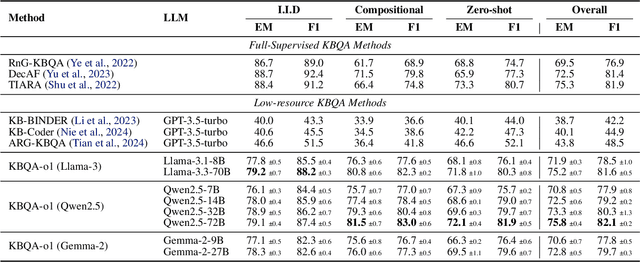
Knowledge Base Question Answering (KBQA) aims to answer natural language questions with a large-scale structured knowledge base (KB). Despite advancements with large language models (LLMs), KBQA still faces challenges in weak KB awareness, imbalance between effectiveness and efficiency, and high reliance on annotated data. To address these challenges, we propose KBQA-o1, a novel agentic KBQA method with Monte Carlo Tree Search (MCTS). It introduces a ReAct-based agent process for stepwise logical form generation with KB environment exploration. Moreover, it employs MCTS, a heuristic search method driven by policy and reward models, to balance agentic exploration's performance and search space. With heuristic exploration, KBQA-o1 generates high-quality annotations for further improvement by incremental fine-tuning. Experimental results show that KBQA-o1 outperforms previous low-resource KBQA methods with limited annotated data, boosting Llama-3.1-8B model's GrailQA F1 performance to 78.5% compared to 48.5% of the previous sota method with GPT-3.5-turbo.
Explaining Model Overfitting in CNNs via GMM Clustering
Dec 12, 2024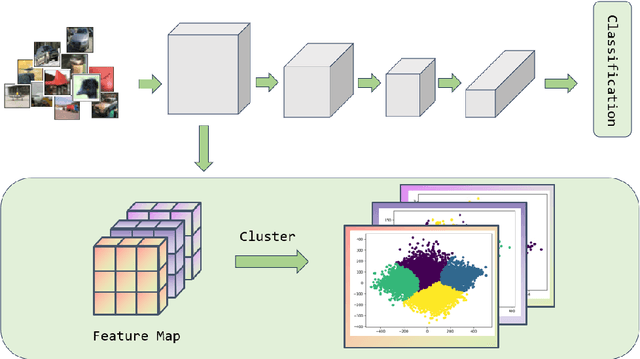
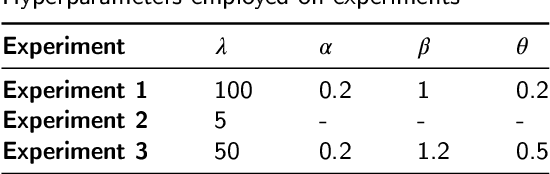
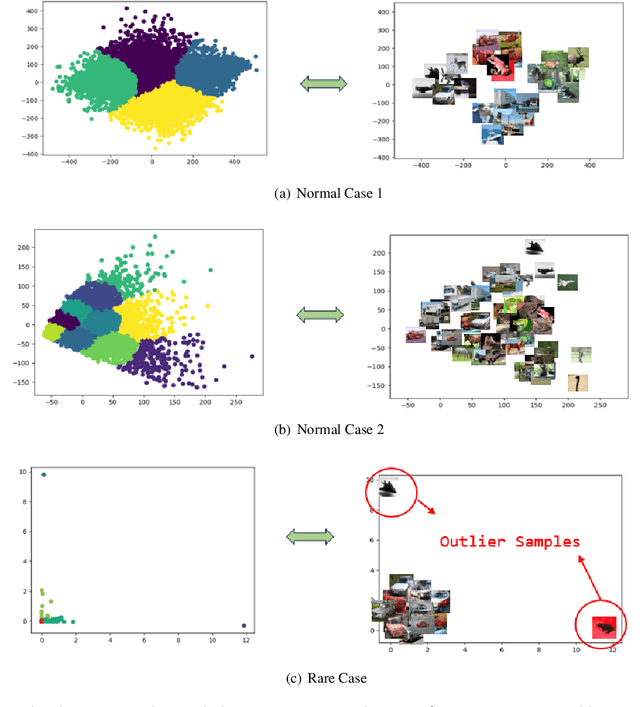

Convolutional Neural Networks (CNNs) have demonstrated remarkable prowess in the field of computer vision. However, their opaque decision-making processes pose significant challenges for practical applications. In this study, we provide quantitative metrics for assessing CNN filters by clustering the feature maps corresponding to individual filters in the model via Gaussian Mixture Model (GMM). By analyzing the clustering results, we screen out some anomaly filters associated with outlier samples. We further analyze the relationship between the anomaly filters and model overfitting, proposing three hypotheses. This method is universally applicable across diverse CNN architectures without modifications, as evidenced by its successful application to models like AlexNet and LeNet-5. We present three meticulously designed experiments demonstrating our hypotheses from the perspectives of model behavior, dataset characteristics, and filter impacts. Through this work, we offer a novel perspective for evaluating the CNN performance and gain new insights into the operational behavior of model overfitting.